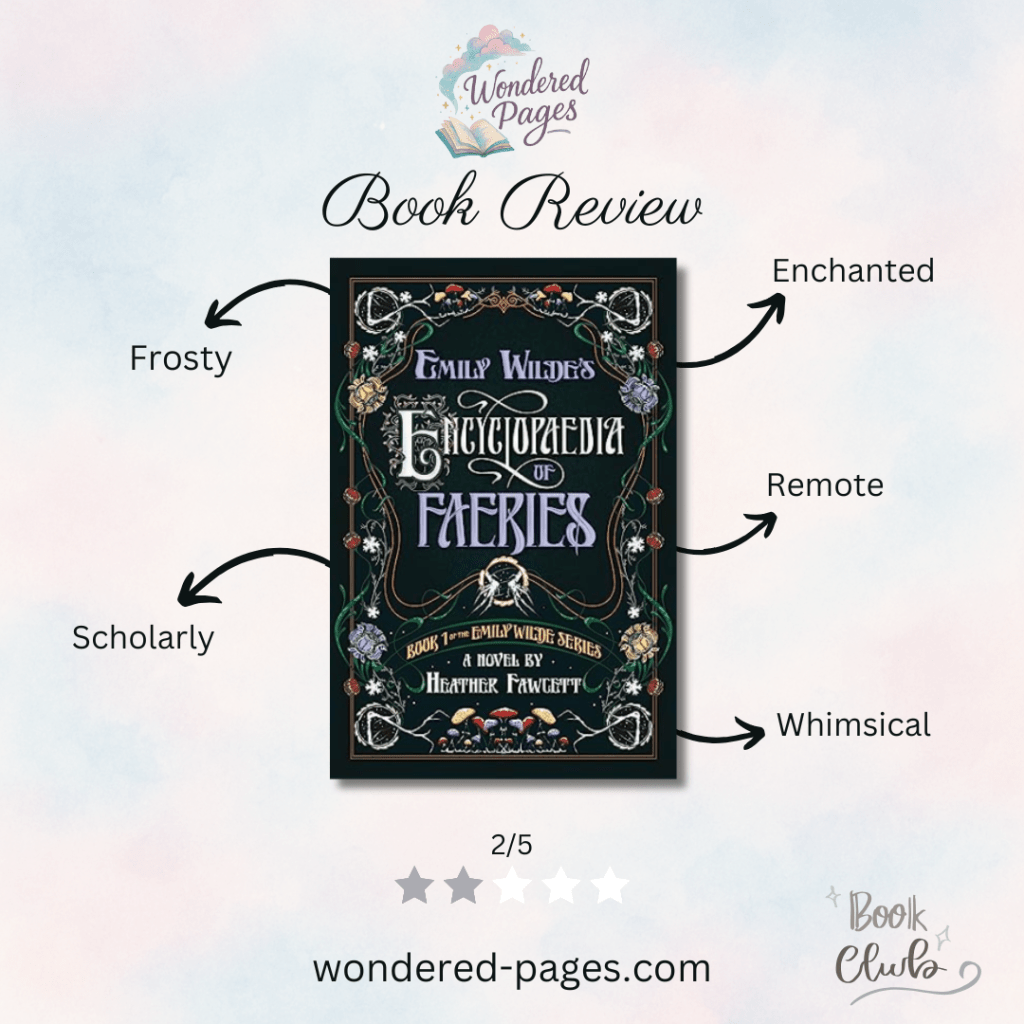
ABOUT THE BOOK
ISBN – 9780593500156
Format – Paperback
YEAR PUBLISHED – 2023
PAGE COUNT – 352
DATES READ – March 13, 2025 – March 16, 2025 (4 days)
STAR RATING – ⭐️⭐️
SPICE METER: 🌶️ 0 of 5
CONTENT WARNINGS – Injury detail, Kidnapping, Blood, Violence, Death, Animal death, Alcohol, Child abuse, Murder
GET YOUR COPY – Barnes and Noble, Powell’s, Bookshop, WorldCat
INITIAL THOUGHTS
Emily Wilde’s Encyclopaedia of Faeries was a book I genuinely struggled to finish. The pacing was slow, the plot meandering, and I found myself watching the page numbers instead of losing myself in the story. I expected a clever academic fantasy with heartwarming or whimsical moments. What I got felt more like trudging through a textbook with the occasional faerie mishap to keep me from dozing off.
WHAT IT IS ABOUT
Cambridge professor Emily Wilde travels to the remote northern village of Hrafnsvik to document the elusive Hidden Ones for her groundbreaking faerie encyclopedia. Though determined to remain solitary, she’s pulled into the lives of the townsfolk and tangled up with the mysterious Wendell Bambleby, her academic rival whose true identity might be more magical than Emily anticipates.
MY REVIEW
Writing Style
Presented as journal entries, the narrative felt distant and clinical. I didn’t realize it was meant to be Emily’s journal until about halfway through. The annotations and pseudo-academic tone made it feel like homework, complete with footnotes that added little value and sometimes detracted from the flow.
Themes & Messages
Themes of isolation, ambition, and reluctant community are lightly touched on but underdeveloped. There’s an attempt to show Emily unlocking her heart or evolving emotionally, but it never quite lands. She starts and ends stiff, and plot devices bury any potential arc.
Characters
Emily is brilliant but painfully bland. Her obsession with work and lack of social skills felt less endearing and more robotic. Somehow, she wins over the whole village and gets two fae kings to propose to her, but there’s no chemistry with anyone, especially not Wendell. He’s the most vibrant character and comes across as a whimsical trickster, which makes him entertaining. Unfortunately, he is also Emily’s savior. Why must a wise woman always need a man to open professional doors?
Vibes, Settings, and Tropes
The isolated, snowy village has cozy, almost folkloric potential but never comes alive. The magical encounters feel forced, and the faerie lore, while creative, often read like stiff inserts. The tropes are there: rivals-to-lovers (sort of), found family, and fae bargains. None of the tropes are explored with depth or satisfaction.
Favorite Quotes
“Get inside! You’re bleeding! I will not bleed any less indoors, you utter madwoman.”
“I will never again believe you to be incapable of hard work. He shuddered, ‘Being capable is not the same as being inclined, Em.’”
“Em, I must confess—I am in awe of you. I believe I am also a little frightened.”
What Worked For Me
This will sound surprising, but Wendell Bambleby was easily the most enjoyable part of the book. His sarcastic, unpredictable charm brought levity to an otherwise rigid and slow-paced narrative. His personality clashed with Emily’s in a way that, while not romantic (in my opinion), at least kept the scenes they shared more dynamic.
I also thought the town of Hrafnsvik and its quirky villagers had potential. Their superstitions, daily routines, and reactions to faerie interference were more engaging than Emily’s internal monologue. If the book had shifted more focus to the village’s culture and how faerie lore shaped it, I might have been more invested.
The idea of presenting the story through academic field notes and journal entries was clever. Though the execution didn’t quite land for me, I can appreciate the novelty and how it might appeal to readers who love detail-heavy worldbuilding and subtle magic systems.
What Didn’t Work For Me
Emily Wilde’s Encyclopaedia of Faeries was a miss in many ways. The “plot reveals” felt either predictable or anticlimactic. A critical scene where Emily remembers a faerie tale mid-battle to save Wendell and randomly conjures a sword while crying? Too convenient. The supposed emotional climax? Emily accepting love or friendship? It just isn’t there. And we don’t even see the final result of a book about writing a legendary encyclopedia! A couple of lines about Wendell getting her on a panel is not enough payoff for the entire arc.
Final Thoughts
Emily Wilde’s Encyclopaedia of Faeries is better for you if you’re looking for an atmospheric, slow-burn fantasy with a sprinkle of folklore and a dose of dry academia. It lacked the magic, romance, and emotional payoff it promised. Wendell was fun, the townspeople were intriguing, and the premise was strong, but the execution left me cold.
Let’s Talk
Have you read Emily Wilde’s Encyclopaedia of Faeries? Did it cast a spell on you or leave you wishing for more spark? Let me know in the comments!


Leave a comment